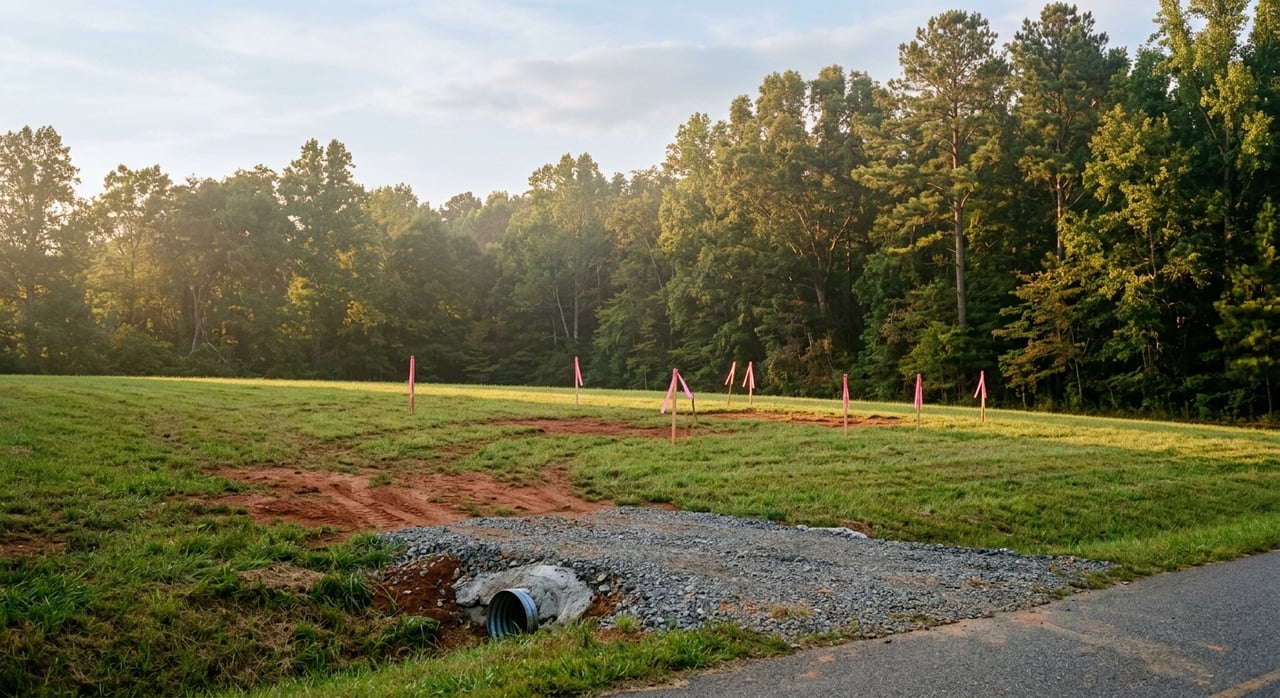
A Smart Guide to Buying Land in Pfafftown
May 7, 2026
May 7, 2026
Buying land can feel simple at first. You find a pretty parcel, imagine your future home or investment, and start making plans. In Pfafftown, though, the smart move is to verify everything before you get too far. This guide walks you through what to check from your first search to closing day so you can move forward with more clarity and fewer surprises. Let’s dive in.
Before you study maps or make an offer, get clear on what you want the land to do for you. Are you planning to build now, hold the property for later, or buy acreage that you may want to split in the future?
That goal shapes almost every step that follows. A lot that works for a future hold may not be ready for a custom build today, and a tract that looks spacious may have limits if you hope to subdivide later. In Pfafftown, raw land is bought through verification, not assumption.
Pfafftown buyers need to pay close attention to parcel location. The joint City-County Planning Division serves Winston-Salem and unincorporated Forsyth County, and Land Use Administration handles rezonings, subdivisions, special use permits, street closings, text amendments, and watershed administration.
That matters because the exact location of a parcel can affect which rules and approvals apply. If you are comparing more than one property, this is one of the first details worth confirming.
Forsyth County offers several mapping tools that can help you screen land before you write an offer. The Planning and Development Viewer is updated weekly, and the county also provides historical imagery from 1951 to 2022.
Those tools can help you spot prior clearing, older structures, and changes to the tract over time. For buyers, that can be useful when you are trying to understand whether a parcel has already been disturbed or how the land has evolved.
The county tax maps are also useful for basic parcel research. They show parcel boundaries, city and town limits, fire districts, and flood plains.
There is one important limit, though. Tax maps do not show zoning, so you should not rely on them alone to decide whether a property fits your plans.
Zoning is one of the biggest checkpoints in any land purchase. If your intended use does not match the current zoning, you may need a rezoning, a special use permit, or another land use approval rather than a simple purchase and build.
This is also important if you think you may divide the property later. Forsyth County’s subdivision process can involve plat review and approval, and planning staff recommends contacting Land Use Administration before submitting a plat for a minor subdivision.
If the property may need a new lot address or street naming work, that is handled through the local planning system as well. These details are easy to overlook early on, but they can affect your timeline.
The most helpful pre-offer research usually comes from a handful of local sources working together. In Pfafftown, your core stack should include:
Forsyth County’s Tax Parcel Viewer and mapping tools are often the first stop for parcel boundaries, ownership, and location information. Because the mapping system relies on real estate records from the Register of Deeds, correctly recorded documents matter.
The Register of Deeds records deeds, mortgages, plats, right-of-way documents, lease and covenant agreements, and other real estate instruments. That record trail can help you understand what has already been placed on the property from a title and document standpoint.
A beautiful parcel is not very useful if access is unclear. If the property will take access from a state-maintained road, NCDOT requires a driveway permit to request access to the State Highway System.
NCDOT also says the buyer should first coordinate with the local governmental authority that controls land-use approvals. The permit must be secured before construction or a change in property use.
This is a good example of why land buying is more technical than home buying. Access is not just about whether you can physically drive to the lot today. It is about whether the property can legally support the use you have in mind.
If the lot is not served by public or community sewer, a septic system will be required. In Forsyth County, the soil and site evaluation is the first step in deciding whether a lot is suitable for septic.
That evaluation is used to issue an improvement permit and authorization for septic tank construction. If you hope to build, this is one of the most important due diligence items to handle early.
If the property will need a water supply well, Forsyth County requires a well construction permit application. The process includes an on-site meeting to issue the permit, followed by inspection and sampling after the well is constructed.
For buyers, the takeaway is simple: do not assume a vacant lot will support septic or a well just because nearby homes do. Site-specific review matters.
Flood risk should be checked separately from zoning and septic. FEMA’s Flood Map Service Center is the official online source for flood hazard information, and FEMA notes that even areas outside high-risk zones are not risk-free.
You should also review whether the parcel falls in a regulated watershed or constrained growth area. Forsyth County and the local planning system publish watershed and growth-management maps, and those layers are worth checking early if you plan to build or split the land.
These constraints do not always stop a project. They do mean you need better information before making a decision.
Land purchases often need a broader team than a standard home purchase. In Pfafftown, the most common specialists include:
For a new house in Forsyth County, the building permit checklist requires a site plan or survey showing property lines, existing structures, the proposed footprint, and setbacks. If the lot will use septic, approval from the Forsyth County Health Department is also required.
That is one reason surveyors and engineers are often involved before closing, especially when buildable area, setbacks, or boundaries are not obvious. If those issues look unclear, it is wise to investigate them during due diligence rather than after you own the property.
In North Carolina, real estate contracts must be in writing and signed to be enforceable between the parties. The standard residential contract commonly includes a due diligence period, which gives you time to investigate the property before closing.
During that period, the due diligence fee is negotiated and paid to the seller by the effective date. If the transaction closes, that fee is credited to you at closing.
The North Carolina Real Estate Commission states that a buyer can terminate during the due diligence period for any reason or no reason. In most cases, though, the due diligence fee is nonrefundable unless the seller materially breaches the contract or an addendum says otherwise.
For land, this period is where much of the real work happens. It is your window to confirm zoning, access, flood concerns, septic suitability, well requirements, surveys, title questions, and any subdivision concerns.
In North Carolina, the closing attorney is chosen by the party seeking representation, not by the broker. Attorneys handle much of the legal work at closing, including title issues and document drafting.
That makes early coordination especially important when the property has any complexity. If access, title, septic, or land use issues need deeper review, it helps to involve the attorney and other specialists sooner rather than later.
After closing, the Register of Deeds records the deed and related land documents. In Forsyth County, that office records deeds, mortgages, plats, and similar instruments.
If you want a simple way to think about the process, follow this order:
That process may feel more detailed than buying an existing home, but it can save you from expensive surprises. The right parcel in Pfafftown can be a great opportunity, but only when the details line up with your plans.
If you are considering land in Pfafftown and want a calm, detail-focused approach, Heidi Christie can help you evaluate the opportunity, coordinate the right local resources, and move through the process with confidence.
August 20, 2026
August 13, 2026
August 6, 2026
August 6, 2026
July 23, 2026
July 16, 2026
July 9, 2026
July 2, 2026

June 25, 2026
Trust her 22+ years of care, discretion, and real estate savvy in Winston-Salem. From residential homes to commercial listings, she brings precision, professionalism, and a seamless experience.